Diamond Dictionary: Asscher Cut Diamond

One of the most elegant and timeless diamond shapes is the Asscher cut.  Nearly 110 years ago, the Asscher cut was designed and patented by Dutch diamond artisan Joseph Asscher.  His brother, Abraham Asscher, furthered their company’s fame in 1903 by cleaving the world’s largest diamond at that time, the 997 carat Excelsior diamond, which later became part of Great Britain’s Crown Jewels.


Key Points to Consider when Buying an Asscher Cut Diamond

1.  Asscher cut diamonds, as well other step-cut shapes, all tend to hide a diamond’s color. For example, a GIA certified I color Asscher cut diamond may ‘face up’ (appear to the naked eye) as an H, or a grade whiter.  With diamond color equating for roughly 55% of a stone’s value, this can be a great advantage to a buyer.

2.  It’s also important to know that a truly gorgeous Asscher can tend to be a little deep in the pavilion and have slightly steeper crown angles.  This can make the face measurements a bit smaller, but allows room for a skilled cutter to build up many layers/steps, thus making for a more beautiful diamond.  It is worth the trade, provided this principle is not taken to the extreme and used as an excuse to make a heavier stone with too much weight left underneath.

3.  Because of the ‘clean’ look of an Asscher cut diamond, buyers should tend to lean up on clarity grades. As long as the inclusion is eye-clean, delicate, white and off to the side of the diamond, buyers may be able get away with a clarity grade of SI1 or SI2, but most Asscher cut diamonds are sold with a clarity grade of VS2 or above.

4.  The GIA (Gemological Institute of America) does not recognize the shape Asscher; instead, it is typically referred to as a “square emerald cut.”  By definition, an emerald cut is a stone that is NOT faceted in the style of a brilliant cut.  The underside of an emerald cut (the pavilion) is cut with layers or “steps.”   One thing is for sure with all step cut diamonds – when the ‘stepping’ and ‘cut corners’ are done properly, the result can be a truly stunning diamond that will be enjoyed for generations.These are just some of the key points to consider when purchasing an Asscher cut diamond.  Because of the complexity involved in cutting a truly exquisite stone, we recommend making sure that you are working with an expert.  Unfortunately, most of the Asschers that we are offered from vendors are cut heavy or sloppy in the corners, thus greatly decreasing their fire, brilliance and desirability and never having a chance of being included in our inventory.  Be sure you are selecting the right diamond … elevate your buying experience and speak with a personal jeweler with Ascot Diamonds before your next fine jewelry purchase.


Posted in Diamond Dictionary, Education | Tagged , , , , , , , , , , , , , , , , , , , , , , | Leave a comment

Dear Santa: All I want for Christmas is a new Diamond Ring!

Diamond Rings for the HolidaysThe holiday season is in full swing and, like everyone else out there, you’re probably getting tired of battling frantic holiday drivers, mad mothers at the mall and hearing a thousand different renditions of the same old holiday songs.

Sometimes it’s not easy to wind down and find some peace during the holidays.  I don’t know about you, but a peaceful ride on a Clydesdale through the snow sounds a lot better than sorting through 100 Groupon and ScoutMob emails for the latest deal of the day.

But what about when Christmas morning arrives and all the noise and pressure has subsided … has Santa Claus (a.k.a. your husband or boyfriend) brought you something you really want this year?   Maybe something like a new diamond engagement ring or diamond band …

So how do you get what you want from Santa this year?  Let’s face it … he knows if you’ve been bad or good.   Assuming that you’ve been good, you’ve got to tell him what you want and here a good place to start – Santa’s Top 10 Diamond Engagement Rings.  It’s time to freshen up your look and reset your diamond in something that you’ll love looking at again each day.

Or, what’s better than 1 diamond ring … how about 2 or 3?!   Call your Personal Jeweler at Ascot today and learn how to put together your own Santa’s Wish List that will ensure that you get exactly what you want under the tree this holiday season!

Stacked Rings - Christmas Diamonds


Posted in Jewelry Humor | Leave a comment

Looking for a unique holiday gift? One diamond ring is never enough …

Stacking multiple diamond rings on the same finger is a great way to give her a timeless and original gift this holiday season.  The beauty of stack rings is that you can add to the look over time… give her one this holiday season, add one for a birthday or anniversary, mark the birth of a child with a “push present” or present one for any milestone in your lives.

Below is a sampling of some of our favorite stack rings, but the possibilities are nearly endless … add in her favorite color with colored diamonds or sapphires, incorporate your child’s birth stone colors, create a custom design, etc.


Diamond Stack Rings and Bands from Ascot Diamonds

Contact your personal jeweler at Ascot Diamonds today to start a custom “stack” just for her, but don’t wait too long – most custom stack rings can take 4-5 weeks for our craftsmen to create!

Posted in Uncategorized | Leave a comment

How Much Should I Spend on an Engagement Ring?

So you’ve finally decided that it’s time to “pop the question” and ask your girlfriend to marry you.  Congratulations!  Now what?!

One of the first questions we hear from guys who are thinking about proposing is, “How much should I spend on the engagement ring?”  Maybe you’ve already heard of the old-fashioned “2, 3 or 4 months salary rule.”  That sounds nice and simple, but there are a ton of different factors that come into play here, one of the primary ones being how old you are.  Couples in their 20′s may be in a completely different financial situation than those in their 30′s, 40′s, 50′s etc.  Plus, with people getting married later in life and most women earning an income of their own, this makes the “x-month salary rule” a bit obsolete.

Wouldn’t it be nice if there was a simple calculator to factor in the intricacies of your relationship, your history apart and together, etc. and spit out a number for you to spend?  Well, there is (sort of).  Check out Engagement Ring Calculator.  I will forewarn you, however, that I filled in the blanks and the number it spit out seemed a bit low when compared to what my girlfriend has hinted that she wants.

This brings up one of the most important and often overlooked considerations when contemplating how much to spend on a diamond engagement ring… what are your girlfriend’s expectations?  Has she always wanted the “perfect diamond engagement ring” – one that you need to stretch your budget on in order to buy and possibly even finance or go into debt for?  Or, would she be happier having a more affordable ring and you not bringing debt into the marriage?

The leading diamond industry periodical, Rapaport Magazine, recently reported that that average amount spent on an engagement ring in the United States is $6,175.*   This amount can deviate greatly based off where a couple lives, their age and socio-economic circle, family background and pressures, etc.

Ultimately, the question of the right amount to spend on a diamond engagement ring involves an honest assessment of your own financial, psychological and emotional beliefs.  There is no right or wrong number.  Remember that this is just the first of several large purchases (wedding bands, honeymoon, wedding, etc.) so it’s important to stay in your comfortable budget range.  Just make sure that you speak with a jewelry professional who asks the right questions and has your best interests in mind.


Rapaport Magazine, page 38, July 2011


Posted in Education | Tagged , , , , , , , , , , , , , , , , , , , , | Leave a comment

Diamond Dictionary: Fancy Colored Diamonds

Colored diamonds relate to white diamonds as a Ferrari might relate to a BMW… magnificent, exotic and different.

Natural colored diamonds exist in a rainbow of colors and intensities.  Less than one percent of the thousands of diamonds graded by the GIA annually qualify as ‘natural fancy colors.’

With colored diamonds the criteria to establish value must be re-aligned. Unlike white diamonds, which are valued for their absence of color, fancy colored diamonds are desired precisely because they have color.

White diamonds are classified on a D to Z color scale, with D being whitest and Z denoting a yellow hue.   Once the color grade goes beyond Z and the hue turns to fancy yellow, also called canary yellow, diamonds become more rare and valuable.

Color ‘intensity’ is described by the GIA as follows (Ascending order of rarity and value):

  1. Faint
  2. Very Light
  3. Light
  4. Fancy Light
  5. Fancy
  6. Fancy Intense
  7. Fancy Vivid
  8. Fancy Deep

The GIA describes color in many interesting ways with are infinite possibilities.

Examples: orangish yellowish pink, greenish yellow purplish pink, pink yellow blue, bluish green, brownish orangy pink, etc.

Often described as ‘canary diamonds,’ yellow diamonds are more reasonably priced than pinks, blues, greens, purples and reds. The more exotic colors can be very rare and quite costly.

Variations in color are caused by the presence of different natural trace elements when the diamond crystallized millions of years ago under enormous heat and pressure.  For example, fancy yellow diamonds have nitrogen in their atomic structure; fancy blue diamonds have boron; fancy green diamonds exhibit natural radiation in the earth; and fancy pink diamonds have traces of titanium.

When cutting and polishing colored diamonds, the priority is to achieve deep, even color distribution, and cutters will often use unusual proportions, facet lengths and angles to optimize color and brilliance.

Clarity in a fancy colored diamond is secondary to color, and the GIA will certify “color only” for a fancy color (if asked to do so).

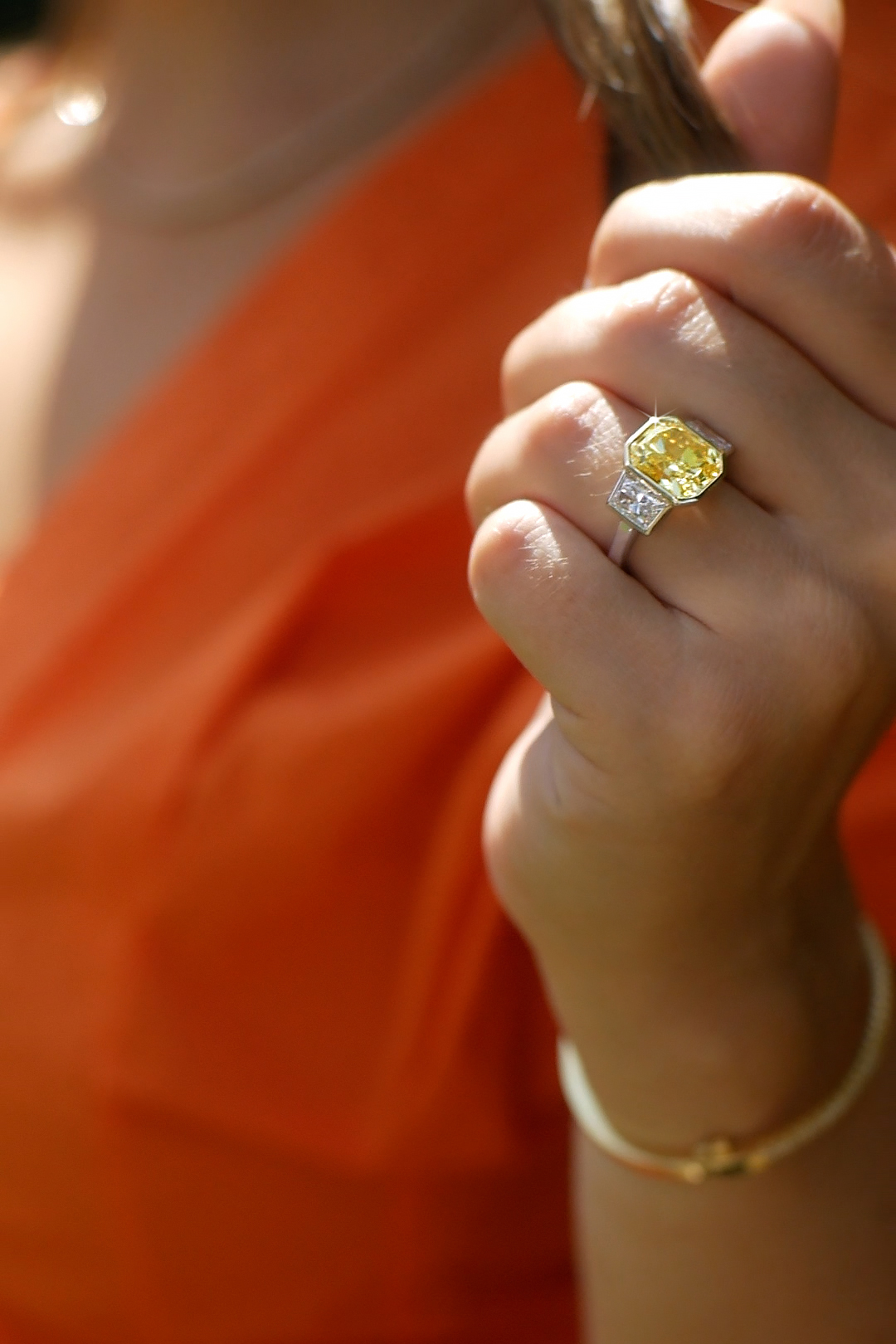
When selecting a fancy colored diamond, remember that each gem is unique… many of the less intense colors have a wonderful charm and a colored stone should be selected because it speaks to you rather than because of details on a certificate.  Colored diamonds often look best when contrasted with fine white diamonds… visit our gallery to view designs from the Catherine Ryder collection.


Posted in Diamond Dictionary, Education | Tagged , , , , , , , , , , , , , | Leave a comment

Diamonds as an investment alternative to the stock market and gold

During a time when the only thing for certain seems to be economic uncertainty, have you considered investing in diamonds?  For months now, you’ve watched your stocks and other investments see-saw while watching gold prices rise.  Now, more than ever, is the right time for a diamond investment.  After all, wouldn’t it be great to enjoy a diamond both to wear in a piece of jewelry and for investment purposes?!

The diamond investment market has seen a robust recovery since the economic collapse devastated the luxury goods market just a few years ago.  Numerous factors play into rising prices, but among the most significant is the recent news of De Beers cutting diamond mining production. With a marked increase in demand from China and diamond supplies simply drying up, De Beers has reduced production in order to extend the life of their mines.  As a result, we expect to see prices continue climbing as the divide between supply and demand widens.  With scarcity comes increased value, making this the optimum time to consider a diamond investment strategy to round out your portfolio.

Take a look at these Ten Year Annual Investment Results comparing diamond investments with other, more traditional, investment options* …

Gold … up 411%
Platinum … up 178%
5.00 carat diamond (RDI) … up 153%
3.00 carat diamond (RDI) … up 95%
$ per Euro … up 38%
Yen per $ … up 38%
1.00 carat diamond (RDI) … up 35%
U.S. interest rate … up 30%
NASDAQ … up 7.8%
Dow Jones … up 7.3%

According to the Merrill Lynch 2011 World Wealth Report, gemstones and jewelry account for 22% of all “investments of passion” for higher net-worth individuals.  Even the affluent urbanites in China are paying attention to the rising value and are “buying diamonds in droves” according to a recent article in Financial Times.

Diamonds are truly timeless, both in beauty and value.  The higher their rarity, the more valuable they become.  As a long term investment, natural diamonds not only maintain their value but appreciate at a far greater pace than most other investment vehicles.  Other advantages of investing in diamonds include:

  • Diamonds are the most concentrated form of storing wealth.
  • Diamonds require no ongoing management, nor do they incur property taxes or require liability insurance.
  • They offer financial privacy not available elsewhere. Unlike other financial investments, a diamond investor has 100% direct ownership of a portable tangible asset of proven value.
  • Diamonds retain their value even when the rest of the economy bottoms out and have performed consistently well throughout economic downturns.
  • There is a nearly universal belief that diamonds have enduring value.
  • Unlike commodities and other investments, diamonds are insulated from the daily fluctuations of the markets and are not as likely to reflect sharp price changes.
  • Demand for diamonds is international.

Diamond investment may not be for everyone, but during such volatile economic times wouldn’t it be wise to invest in an asset that not only stands a great chance of appreciating and looks great in a stunning piece of jewelry?

(December 2000-December 2010, courtesy of Rapaport Diamond Report, 2011. RDI is the average price per carat for D-H, IF-VS2, VG+ diamonds)
Posted in Education | Tagged , , , , , , , , , , , , , , , , , , , , , | Leave a comment

Platinum vs. White Gold: The right metal for your engagement ring

One of the questions we seem to frequently get asked is, “What is the difference in platinum versus white gold when it comes to selecting the right metal for my diamond engagement ring?”  For our personal jewelers, the answer typically depends on a number of factors, such as:

  • What is your budget range for the project / can extra be allocated for platinum?
  • Are you comfortable knowing that white gold will require ‘dipping’ or ‘rhodium plating’ on a fairly consistent basis in order to retain its crisp, white appearance?
  • Does your occupation put you in constant contact with chemicals, require you to wear gloves or make it so you wash your hands frequently?

Main advantages of platinum over white gold…

  • Platinum (especially the highest grades of 900 and 950 like we use) is noticeably whiter because it is an intrinsically white metal, whereas white gold has been mixed with silver and other alloys in order to make it ‘appear white.’
  • White gold will inevitably lose the whiteness of its appearance over time.   Engagement rings will begin to fade towards yellow, especially underneath the ring or in areas of higher wear and tear.  The process our jewelers use to make white gold pieces regain their white appearance is called rhodium plating (a.k.a. ‘dipping’ your rings).  Although a relatively inexpensive process, it is more a matter of the time required, the frequency that you need this done and the skill level of the craftsmen who plate your jewelry.
  • Platinum is a stronger and more durable metal.  In terms of scratching or becoming dull over time, both platinum and white gold engagement rings require regular maintenance from time to time (polishing and cleaning).
  • In general, we have found that far fewer clients have allergies to platinum than white gold.  Typical allergic reactions to can include a rash, redness, swelling or infection.  Most of these symptoms can be tracked back to one of the secondary alloys in white gold or a reaction to certain chemicals or products that the customer comes in contact with on their hands.

Budget permitting, we recommend platinum in engagement rings because of the wear and tear that they incur.  A typical diamond ring in platinum will cost approximately $700-$1,200 more than its 14 or 18 karat counterpart.  If this amount can be better spent by our customers on the center diamond or elsewhere, we are comfortable suggesting white gold – you just need to be aware of the pros and cons.

For most other types of diamond jewelry (necklaces, earrings, bracelets, etc.) white gold is generally suitable, as the wear and tear is typically less in these items.

Bottom Line:   polished platinum is brighter, stronger and will always be white.  Budget permitting, it is the correct metal choice for an important piece of fine jewelry like an engagement ring – no question.


Posted in Education | Tagged , , , , , , , , , , , , , , , , , | Leave a comment

How to Buy a Cushion Cut Diamond Engagement Ring

First developed in the early 1900′s, the Cushion Cut diamond shape has soared in popularity over the past decade.  The modern day cushion is a descendant of the Old Mine Cut.  When cut properly, a Cushion Cut diamond can be breathtaking … it’s rounded corners and 58 brilliant-style facets working together to create a soft, pillow-like shape.

Pave Diamond Engagement Ring

Pave Diamond Engagement Ring

Selecting a truly beautiful Cushion Cut diamond should require the assistance of an expert in the diamond industry, as a lot of these shapes tend to be asymmetrical or carry too much weight underneath the stone.  Whereas a Round Brilliant diamond has a lot of science behind the ‘proper’ depth and table ratios, a Cushion Cut diamond is more of a 50/50 mixture of science and art.  Each Cushion Cut diamond has it’s own personality with some being more ‘pillowy’ on top, softer or more-pronounced in the corners, varying table size, etc.  Overall, the talent of the cutter is the #1 factor behind the brilliance and beauty of the diamond.

There are many factors that should be considered when purchasing a Cushion Cut diamond and they ALL boil down to one thing –  there is ALWAYS a reason for every price.

2.01 Carat Cushion Diamond Comparison

2.01 Carat Cushion Diamond Comparison

Here is a recent example that we worked on … a client was looking at another diamond wholesaler’s 2.09 carat Cushion Cut diamond that measured 7.60 x 7.35 mm with a depth of 68.8%.  At first, he was excited about being able to buy a weight of over 2.00 carats as the center diamond in his girlfriend’s diamond engagement ring.  What he quickly learned through our education was that these measurements and depth percentage make for a small Cushion Cut diamond.   In fact, that 2.09 stone was noticeable smaller that our 1.90 carat, which measured 8.05 x 7.18 mm and had a depth of 65.9%.  Not only did our client end up getting a larger diamond in terms of the ‘spread’ or ‘look’ of the stone, but he saved money too.

Another factor to consider are ‘cut grades’ on Cushion Cut diamond certificates.  It is our opinion that cut grades on certificates for Cushion Cut diamonds should NOT be factored into exactly how beautiful the stone will appear to the naked eye.  Often times a polish-symmetry of Good-Good can be more brilliant that an Excellent-Excellent.  This is just another reason why it is so important to be guided by a true industry expert while selecting your diamond.

Cushion Diamond Engagement Ring

Cushion Diamond Engagement Ring

Together with our partners, the Ascot group has been in the diamond business for over thirty three years.  Our specialty is servicing the discerning buyer who wants a selection of the “best of breed” diamonds from around the world. In fact, less than 5% of the world’s cut diamonds qualify for our inventory so you can rest assured that you will be only be selecting from the finest examples of each grade.


Posted in Diamond Dictionary, Education | Tagged , , , , , , , , , , , , , , , , , , , , , , , , , | Leave a comment